Blog ·
Christopher Nolan IMAX Movies: From The Dark Knight to The Odyssey
Christopher Nolan’s IMAX movies begin with The Dark Knight (2008), the first major feature film to be shot even partially with IMAX cameras, and run through The Odyssey (2026), which IMAX describes as the first feature film shot entirely with its film cameras. In between, The Dark Knight Rises, Interstellar, Dunkirk, Tenet and Oppenheimer each combined IMAX footage with other film formats.
Nolan’s IMAX films in release order
These are the Nolan films with IMAX camera footage. The figures come from interviews and trade reporting rather than one official count, so where sources differ, both numbers are given. Release dates and runtimes for every title are in his full filmography.
- The Dark Knight (2008): six sequences shot with 70mm IMAX cameras. Polygon counts 28 minutes of IMAX footage in the finished film; The New York Times put it at 30.
- The Dark Knight Rises (2012): 72 minutes of IMAX footage, which The Guardian reported as the most ever for a studio narrative feature.
- Interstellar (2014): a combination of Kodak large-format film for IMAX capture and 35mm, according to Kodak. It began Nolan’s collaboration with cinematographer Hoyte van Hoytema.
- Dunkirk (2017): Kodak estimated 75 percent IMAX footage, while IndieWire gives 70 percent. The rest was shot on 5-perf 65mm.
- Tenet (2020): 50 percent shot with IMAX cameras, according to IndieWire.
- Oppenheimer (2023): IMAX and Panavision large-format cameras, with the crew using IMAX whenever possible, per IndieWire.
- The Odyssey (2026): shot entirely with IMAX film cameras.
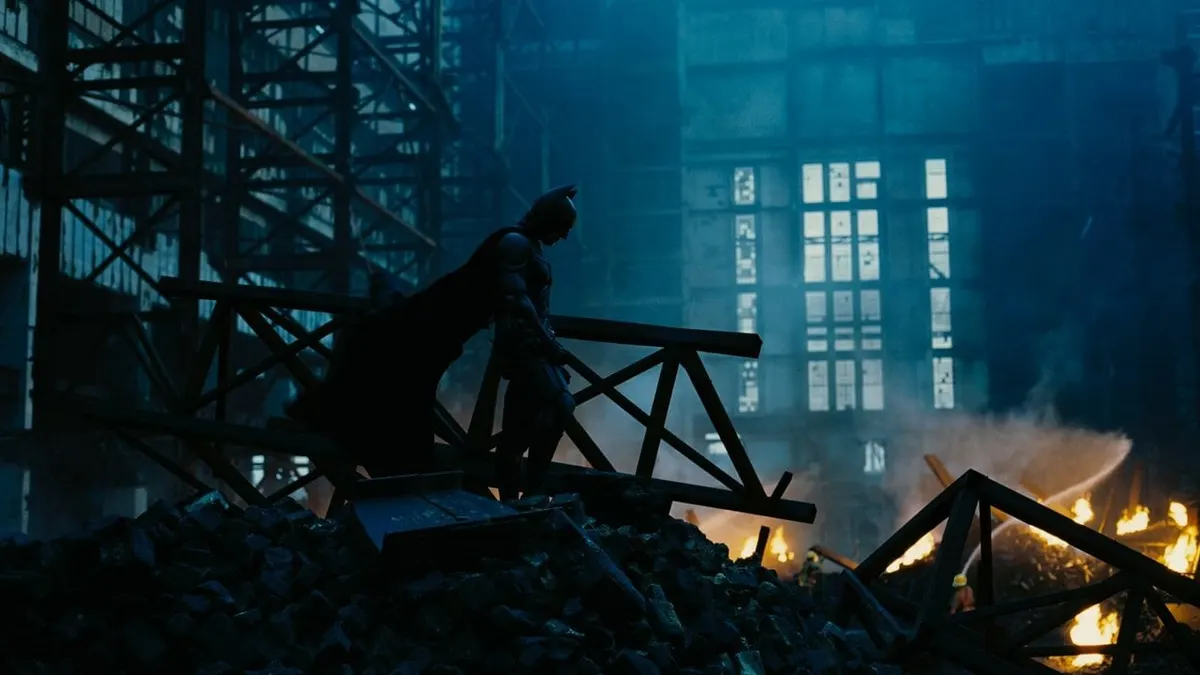
The Dark Knight and the first IMAX sequences
Before 2008, IMAX “had been known best for short documentaries about ocean life and space travel,” as The New York Times put it. On The Dark Knight, Nolan shot six major action sequences with IMAX cameras, including the opening six minutes and the Joker’s first appearance, Deadline reported on the film’s release day. Polygon adds the chase through the streets of Gotham to that list.
In IMAX theaters, the scenes shot on 15/70mm film expanded vertically to fill the entire screen, while the rest of the film played letterboxed. That jump in size, on screens Deadline noted can be up to eight stories tall, became a Nolan signature.
Nolan has explained how he got the cameras onto a studio blockbuster: “I’d seen IMAX films in museums and was fascinated about it as a kid and used the fact that I was doing a [Batman] sequel to negotiate with the studio about using it as a camera,” he told IndieWire. The IMAX midnight previews set a record of $640,000, according to Media By Numbers figures reported by Deadline.
Four years later, The Dark Knight Rises pushed the IMAX footage to 72 minutes. The Guardian’s description of the equipment shows what that cost on set: “cumbersome, jitter-sensitive and noisy cameras capable of only three-minute takes”.
Why Nolan chose IMAX cameras
Nolan’s own answer starts with image quality. “IMAX film is the highest resolution film that’s ever been used, but it had never been used in Hollywood films until ‘Dark Knight,’” he told IndieWire, which says the format offers 10 times the resolution of standard projection formats.
The second reason is immersion. “What large-format photography gives you is clarity, first and foremost,” Nolan said in the Oppenheimer production notes. “It’s a format that allows the audience to become fully immersed in the story and in the reality that you’re taking them to.” On that film, IndieWire reported, he and van Hoytema turned the IMAX camera on both the landscapes of Los Alamos and Oppenheimer’s face.
The format also fits his loyalty to celluloid. “Chris is a champion of film, so Dunkirk was always going to be a film project,” van Hoytema told Kodak, and Polygon describes Nolan as an “avowed, ardent supporter of shooting and projecting movies on film.”
The technical difference is the frame itself. IMAX uses the same Kodak 65mm stock as standard large-format shooting but runs it horizontally, 15 perforations wide, for a 1.43:1 image; 5-perf 65mm gives 2.2:1. That is why Oppenheimer switches between 2.20:1 and 1.43:1 in IMAX 70mm (IndieWire).
Why Nolan mixed IMAX with 65mm cameras
For most of his career, the limiting factor was noise. “Whilst we wanted to tell the story with as much clarity as possible, IMAX cameras are noisy on set,” van Hoytema told Kodak about Dunkirk. “So, we shot IMAX film whenever we could and used the next best film format, 5-perf 65mm, for the dialogue scenes. It was purely a practical decision.”
The noise did not stop them pushing the cameras around. Van Hoytema operated the IMAX and 65mm cameras handheld, and the crew engineered mounts to put IMAX cameras on ships and airplanes, according to Kodak’s account of the production. More than 120 70mm prints and 35 IMAX film prints were made for the film’s worldwide release.
Oppenheimer followed the same pattern, IndieWire reported: IMAX cameras alongside Panavision System 65 Studio cameras, “primarily due to sound issues with the noisy IMAX camera.” It also needed a first from Kodak, which had never finished 65mm black-and-white film for IMAX. In IMAX 70mm, the 180-minute film switches between 2.20:1 and 1.43:1 throughout.

The Odyssey: shot entirely on IMAX film cameras
The Odyssey removed the compromise. According to IMAX, it is the first feature film shot entirely with IMAX film cameras, including the new IMAX Keighley Film Camera, named after the late David Keighley, IMAX’s Chief Quality Officer, and his wife Patricia. The production shot 2.1 million feet of film, IMAX says.
Gold Derby called it the first narrative movie shot entirely in 65mm IMAX, and noted that van Hoytema had shot Nolan’s previous four features principally with IMAX cameras. Van Hoytema sees the all-IMAX shoot as the end of a long process: “This was the perfect storm, but it was not possible without the evolutionary steps that we had to take before that.”
The Odyssey opened on July 17, 2026, runs 173 minutes and has grossed $1,804,356,298 worldwide (Box Office Mojo, as of November 11, 2026). Variety reported that it became the highest-grossing IMAX film of all time, with $550 million worldwide on IMAX screens, and set the record for the biggest domestic opening in IMAX 70mm. IMAX posted the best quarter in its history on the back of it, and CEO Rich Gelfond called the moment an “awakening” for the platform, Forbes reported.
Films shot 100% in IMAX
Wikipedia’s list of IMAX films keeps separate categories for films shot entirely and partially with IMAX 70mm cameras, and others for IMAX-certified digital cameras such as the ARRI Alexa IMAX. In the all-film category, it lists The Odyssey as the first narrative feature film entirely shot in IMAX 70mm. By the figures above, every earlier Nolan film belongs in the partial category.
The projection format matters as much as the camera. For Oppenheimer, IndieWire explained, the 70mm IMAX version was fully analog, while the digital IMAX version was made from 8K scans of the original film and scaled to 4K for laser projectors.
Where to see Nolan’s films in IMAX 70mm
IMAX 70mm screens are scarce. For Oppenheimer in 2023, IMAX said 30 theaters out of a possible 50 worldwide would show it in 70mm IMAX, including 19 in the U.S. and six in Canada. The prints are enormous: the TCL IMAX Chinese Theater in Hollywood needed a larger projection booth for an Oppenheimer print of 53 reels, weighing 600 pounds and spanning 11 miles, IndieWire reported.
Repertory runs keep the older films in circulation. Cineworld brought eight Nolan films, including the full Dark Knight trilogy, back to IMAX screens in the UK and Ireland in August 2025. BFI IMAX in London ran a monthly strand of IMAX 70mm prints from January to June 2026, from the Dark Knight trilogy through to Oppenheimer, ahead of The Odyssey.
Two dates are next. The Odyssey returns to more than 1,000 screens in the U.S. and Canada from December 11, including IMAX 70mm, Variety reported, after its home release on November 17. Then The Prestige comes back on January 29, 2027, for its 20th anniversary, playing on 70mm and IMAX screens for the first time. “I’m very excited to bring ‘The Prestige’ back to the big screen, and particularly thrilled to offer audiences the chance to see it on 70mm film, and on Imax for the first time,” Nolan said.
That return has a neat twist. Gizmodo notes that The Prestige “is considered to have the first-ever IMAX 70mm shot used for a narrative-length film,” in a scene with Christian Bale’s duplicated character. Two years before The Dark Knight, the format was already in Nolan’s toolkit, if only for a moment.
Questions
01Which Nolan movies are shot on IMAX?
The Dark Knight, The Dark Knight Rises, Interstellar, Dunkirk, Tenet and Oppenheimer were all shot partly with IMAX film cameras. The Odyssey (2026) was shot entirely with IMAX film cameras. The share of IMAX footage grew from about half an hour in The Dark Knight to 72 minutes in The Dark Knight Rises and an estimated 70 to 75 percent of Dunkirk.
02Why does Christopher Nolan film in IMAX?
Nolan has called IMAX film the highest resolution film ever used, and he says large-format photography gives clarity first and foremost. He also describes it as a format that lets audiences become fully immersed in the story. It fits his long-standing support for shooting and projecting movies on film.
03Which movies are 100% IMAX?
The Odyssey (2026) is the first feature film shot entirely with IMAX film cameras, according to IMAX. Wikipedia's list of IMAX films lists it as the first narrative feature entirely shot in IMAX 70mm. Earlier Nolan films, such as Tenet (50 percent IMAX according to IndieWire), mixed IMAX with other formats.
04Was The Dark Knight the first IMAX movie?
No. Before it, IMAX had been known best for short documentaries about ocean life and space travel (The New York Times). The Dark Knight (2008) was the first major feature film to be shot even partially with IMAX cameras, using them for six sequences, including the opening six minutes.
05When is The Odyssey back in IMAX 70mm theaters?
Universal is re-releasing The Odyssey on more than 1,000 screens in the U.S. and Canada starting December 11, 2026, including IMAX and IMAX 70mm, according to Variety. The film had already had a limited IMAX and IMAX 70mm return in early October. It reached homes on November 17.